If you spend most of your working day at a screen and your neck aches by mid-afternoon, you are not alone and you are almost certainly not damaged. Neck pain is the fourth leading cause of disability worldwide, with a prevalence rate of over 30% of the population in any given year, according to data cited by the Mayo Clinic Health System. In desk workers, the numbers are worse, with studies consistently finding that between a quarter and half of office-based workers report neck pain each year.
The honest summary: it is a mechanical problem, not a structural one. And understanding the difference matters a lot for how you fix it.
Why desk work actually hurts your neck
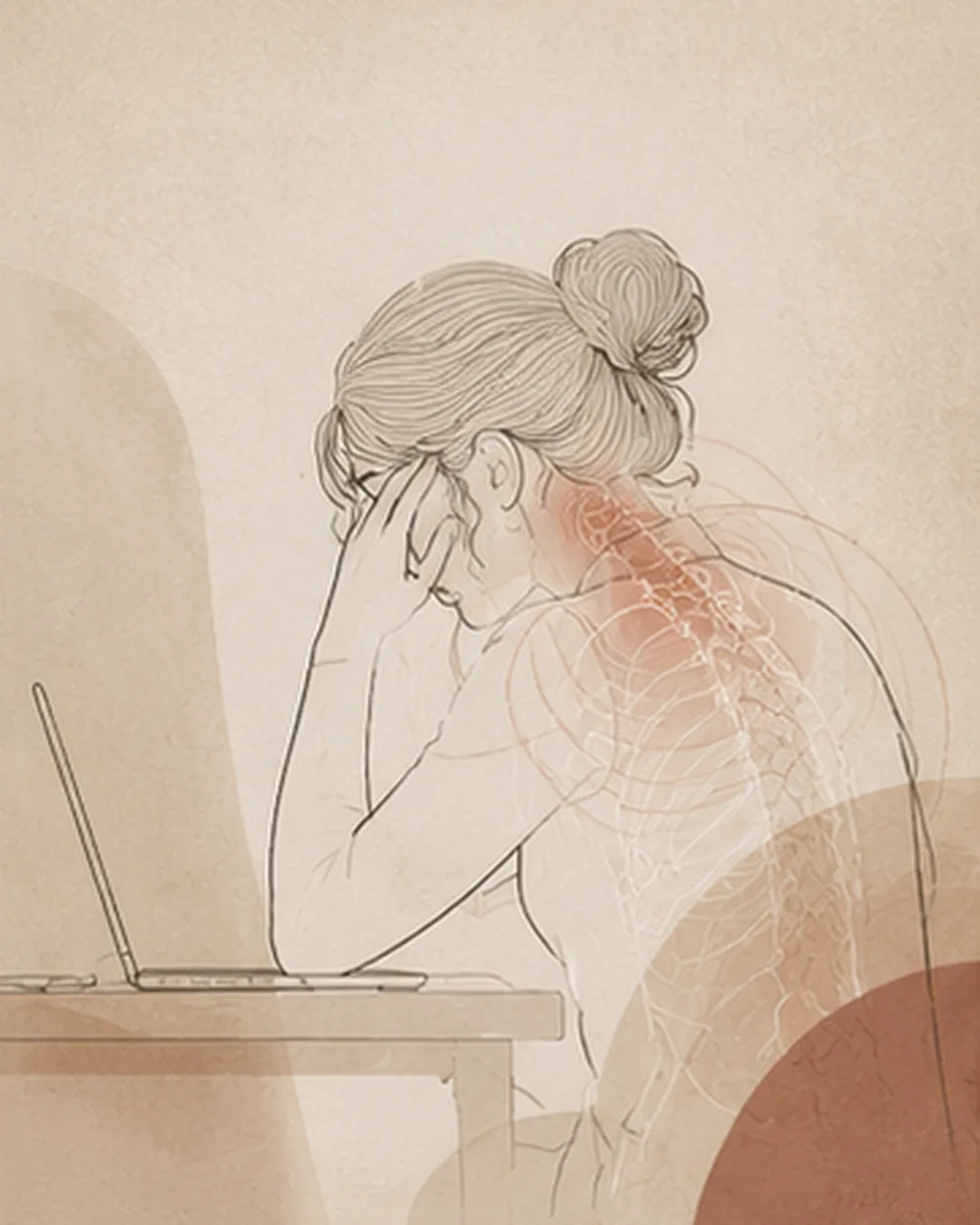
The problem is not really your posture in the way most people think. It is sustained load with no variation. Your neck is designed to move, and when you hold any position for hours at a stretch, the muscles and joints stop getting the varied loading they need. They fatigue. They become sensitised. And eventually they hurt.
The forward-head position that comes with screen work makes this worse because it increases the effective weight your neck has to support. An adult head weighs roughly 10 to 12 pounds balanced directly over the spine. For every inch it drifts forward, the load on the cervical spine roughly doubles. So by the time you are in that familiar slumped laptop position, your neck muscles are working significantly harder than they should be for hours at a time.
Working from home has made this worse for a lot of people. Office setups at least tend to have fixed desks and monitors at eye level. Home working often means a laptop on the sofa, a screen that is too low, and fewer reasons to get up and walk anywhere.
What the pain actually is
For most people with desk-related neck pain, the problem is a combination of things happening together:
- Overworked, tight muscles at the back and sides of the neck, particularly the upper trapezius and levator scapulae
- Stiff joints in the mid and upper cervical spine that have been in the same position for too long
- Weak deep neck flexors, the small muscles that are supposed to stabilise the front of the neck, which switch off when you spend all day jutting your chin forward at a screen
- Referred symptoms including headaches, a general heaviness across the shoulders, and occasionally a dull ache into the upper arm
None of this is damage. It is tissue that is tight, stiff and underworked in certain directions. That is exactly what osteopathy works on.
What osteopathy can help with
The NHS notes that there is evidence osteopathy may be effective for some types of neck pain. In practice, for the kind of postural, desk-related neck pain described above, hands-on treatment can make a real difference to how quickly you get out of it and how comfortable you feel in the meantime.
What I am doing in a session is working on the soft tissue and joints that have become restricted and sensitised. That might mean releasing tight muscles through the upper back and neck, mobilising stiff cervical joints, and working on the thoracic spine, which is often the overlooked part of the picture. Stiffness through the mid-back forces the neck to compensate and take on more movement than it should.
I will also give you specific things to do between sessions, because treatment alone without changing how you load your neck day to day will just keep bringing you back.
The headaches that come with it
A lot of people do not connect their headaches to their neck, but if yours tend to start at the base of the skull or the top of the neck and radiate forward over the head, there is a good chance that is exactly what is happening. These are called cervicogenic headaches, and they are driven by restriction and irritation in the upper cervical joints rather than anything happening in the head itself.
They are common in desk workers, they are often misidentified as tension headaches or migraines, and they respond well to treatment directed at the neck.
What osteopathy cannot do
It cannot change the fact that you sit at a desk for eight hours. It can settle the current pain and get you moving better, but the underlying issue is a load management problem and that requires changes to how you work and how strong your neck and upper back are. Treatment that does not come with a plan for that is just managing symptoms.
If you have any of the following, please see your GP rather than booking with me first:
- Weakness, heaviness or loss of coordination in your arms or hands
- Numbness or pins and needles that run all the way into your fingers
- A severe headache that came on suddenly, or headache with dizziness, vision changes or confusion
- Neck pain following a fall or impact
- Night sweats, unexplained weight loss or fever alongside the pain
These are not typical desk-neck symptoms and need to be checked out properly. When the picture is straightforward mechanical neck pain, which most of the time it is, osteopathy is a sensible first step.
What you can do now
A few things make a meaningful difference before you come in, and are worth doing regardless:
- Get your screen to eye level. If you are on a laptop, a separate keyboard and a stand or a stack of books is genuinely enough
- Move every 30 to 45 minutes. Not a stretching routine, just stand up, walk to the kitchen, look out a window. Variation is the point
- Chin tucks: gently draw your chin straight back, hold for a few seconds. This reactivates the deep neck flexors and counteracts the forward-head drift. Do them little and often throughout the day rather than in one big batch
These will not fix a neck that is already painful and stiff, but they will stop it getting worse and they will make treatment stick faster when you do come in.
My approach
I work exclusively with women, and desk-related neck pain is one of the most common things I see. In my experience, it tends to come in waves, where it is fine for a while and then a busy week or a poor night's sleep tips it over. The goal is not just to get you through the current flare. It is to get your neck strong and resilient enough that the small stuff stops tipping it over.
That means hands-on treatment to settle things down, and a clear plan for what to load and how. I want you to need me less, not more.
Common questions
Is neck pain from desk work serious?
In the vast majority of cases, no. It is a mechanical problem, not damage. The red flags to watch for are listed above, but if your neck just aches and stiffens through the working day, that is a load management issue, not something sinister.
Can osteopathy help headaches caused by my neck?
Yes. Cervicogenic headaches, those that start in the neck and radiate forward, often respond well to hands-on treatment directed at the upper cervical spine. They are frequently misidentified as tension headaches or migraines.
How long will it take to get better?
Most people with straightforward desk-related neck pain see meaningful improvement within two to four sessions, especially when combined with changes to their setup and daily movement. There is no reason it should take longer than that unless there is something more complex going on, and I will tell you if that is the case.
Do I need to change jobs or buy an expensive chair?
Almost certainly not. Small, free changes to screen height and movement habits make the biggest difference. I will help you figure out what is actually relevant to your setup.
Last reviewed by Amina Shamsi M.Ost, June 2026
Osteoxfit is based in Chelsea SW10, within easy reach of Kings Road, Sloane Square, Fulham, Kensington and Knightsbridge. I work exclusively with women. No GP referral needed. This article is general information, not personal medical advice. If you are unsure about your symptoms, speak to your GP.
Neck pain in Chelsea SW10.
If your neck has been grinding you down and you want an honest assessment rather than an indefinite treatment plan, get in touch.
Message on WhatsApp